Many patients show me their MRI report and asked me about the interpretation of the spine Modic change signal in the report. Now this article will guide the readers to understand the impact of Modic changes on low back pain.
What Is Modic Variation?
Modic variants often occur in the spine and intervertebral disc and can only be seen in magnetic resonance scans. Dr. Michael Modic first analyzed and described Modic changes in the spine and intervertebral discs in 1988, these changes can be described in three types based on the condition of lower back pain. Type I, Type II and Type III.
Modic grading can be used as a key indicator for the diagnosis of low back pain.
Low back pain caused by Modic changes is one of the common causes of spinal stenosis and disc herniation. Studies have shown that Modic changes have a lot to do with low back pain , especially in type I, patients will continue to have low back painin the morning or evening , or they may have low back pain and are unable to fall asleep.
Modic Type I
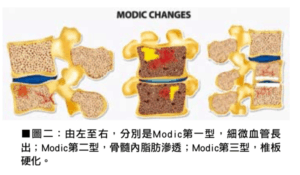
From the magnetic resonance scan, the microvascular vessels shows abnormal elongation, inflamed and edematous on the lamina with no significant bone marrow change.
Modic Type II
From the magnetic resonance scan, the bone marrow began to lose its normal appearance, as the bone marrow visceral fat is being penetrated.
Modic Type III
This is a very rare situation. In addition to the patient feeling low back pain, the magnetic resonance scan will show that the patient has laminar sclerosis and a small amount of fracture.
Modic type 1, 2 and 3 photo
Modic type 1 (far left) – blood vessel grow inside vertebral bone
Modic type 2 (middle) – fatty marrow inside vertebral bone
Modic type 3 (far right) – laminar sclerosis and a small amount of fracture.
Patients with Modic variants tend to be of older age and have more severe disc disease. Studies have shown that suffering from Modic changes is associated with long-term severe low back pain . Type I patients have more severe lumbar pain than type II patients, while type III patients are associated with lower limb numbness. Magnetic resonance scanning reveals and refers to changes in the spine Modic and the shape and extent of the spine. It can be used as a key indicator for the diagnosis of lower back pain. The doctor can better understand the cause and severity of low back pain in individual patients and set up treatment plans for the patient.
How to deal with Modic Lesions:
In addition to the symptoms of lumbar pain of Modic Type I and Type II, the most important thing is to strengthen and stretch the lower back muscles to decrease the symptoms of lower back pain.