Causes and symptoms of annulus fibrosus tear
36-year-old Ms. Chu is going to participate in the annual marathon. She started training as early as the beginning of last year, during the training, she also had several symptoms of the low back pain. The pain persisted from mild to moderate, but when she stopped training the back pain disappeared. But when she runs again the pain comes back. What caused this problem?
Case Sharing
Ms. Chu practiced running until her low back pain suddenly worsened in early November last year. No matter how she rested, she showed no signs of getting better. After physical therapy and stop running, her pain improved, but the back pain recurred after she resumed running. This time when standing, sleeping, and getting up, her low back hurts when she turns around. After diagnosis, it was confirmed that Ms. Chu’s symptoms were caused by a tear in the lumbar intervertebral disc.
The intervertebral disc (cartilage) is located between the vertebrae. It is made up of the inner nucleus (jelly filled ) and the outer fibrous annulus ligament. It resembles an onion ring and is composed of layers. The role of the intervertebral disc is to absorb the pressure on the spine, and also has the effect of shock absorption. When we move the body, bend forward or backward, the cartilage also takes different shapes to match the body’s movements.
Cause
As people grow older and bear long-term body weight, the nucleus pulposus will begin to be dehydrated and deteriorated by the age of 35, and the ability to absorb stress will also decrease. At the same time, the fibrous annulus will begin to degenerate. When we make some improper postures or movements, it may cause some cracks (tear)in the outer fibrous ring due to compression or sudden shocks, which will cause the cartilage exert the pressure. Chemical protein leak out from the tear annular fiber and the nerve roots get irritated, that might causing pain in the lower back and feet. This condition is very common in high-intensity sports such as football and long-distance running.
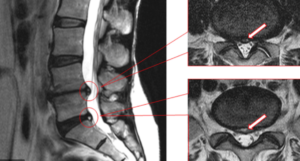
Symptoms
Because fiber ring tearing causes the vertebrae to flow out of the vertebral nucleus with chemicals that produce extremely high inflammatory properties, exacerbating the pain of the nerve roots.
Patients with fibrous ring tearing generally have several conditions: the condition is more acute, and the symptoms of getting up in the morning are more serious; Patients generally can not sit for a long time, can not stand for a long time can not move, lying down trigger pain; Patients usually have more pain in their lower backs than in their feet, and if foot pain occurs, it can extend to one or both feet; Increased pain in the lower extremities when coughing, sneezing or defecation; When examining the nerves of the lower extremities, there is referral pain (like the disc protruding), However, the scan only showed that the fiber ring tearing, and there is no disc protrusion problem, and therefore misjudged muscle or joint strain, which indirectly affecting the treatment outcome.
Therefore, to accurately diagnose a patient’s illness, we should not only rely on observation and scanning images, but also carefully listen to the patient’s medical history in order to make accurate clinical diagnosis
Treatment
Cox® Technic is appropriate for conditions causing low back and leg pain as well as neck and arm pain. It also reduces pain attributable to:
- Disc herniation/a slipped disc/ a ruptured disc
- Sciatica
- Stenosis
- Spondylolisthesis
- ( suitable for osteoporosis elders and pregnant women)
Cox® Technic is a well-researched, well-documented and proven effective technique for decompressing spinal nerves and treating back and neck pain. It is a gentle, non-surgical, low-force procedure which helps the spine heal properly – and keeps it as pain free as possible.
“Evidence-based protocols are tested in laboratory trials and clinical trials supported by privately funded, clinician-volunteer, and federally funded research grants through the United States National Institutes for Health (NIH) and Health Resources and Services Administration (HRSA) to name a few.” – From official website of Cox® Technic
These evidence-based protocols are well-defined in medically published textbooks and peer-reviewed journal articles. You may visit the official website of Cox® Technic or to know more about this evidence-based chiropractic care and its related research and publications.